If you'll drink it daily for 40 years…
What kind of coffee do you want in your cup?
The goal isn't more coffee.
It's better coffee.
It's better coffee.
For many of us, coffee isn't occasional. It's daily. Two cups. Maybe three. Year after year. When something becomes a 30- or 40-year habit, quality starts to matter in a very different way.
Recently, long-term research has added new depth to the conversation around coffee and health. Rather than short-term performance boosts or metabolism claims, scientists have been asking a bigger question:
What happens when people drink coffee consistently for decades?
Let's look at what the evidence actually says — and what it doesn't.
What 40+ Years of Research Found
A major long-term study published in JAMA Network Open followed more than 130,000 participants for up to 43 years.
Researchers found that people who drank about 2–3 cups of caffeinated coffee per day had an approximately 18% lower risk of developing dementia compared to very low or non-coffee drinkers.
A few important nuances:
- The association was strongest for caffeinated coffee.
- Benefits appeared at moderate intake levels, not extreme consumption.
- This was an observational study — meaning it shows correlation, not proof of cause and effect.
In parallel, findings published in The Journal of Nutrition have linked moderate coffee intake (around 3–5 cups per day in some cohorts) with:
- Lower overall mortality
- Reduced risk of cardiovascular disease
- Lower incidence of type 2 diabetes
- Markers associated with healthier aging
Again, these are associations — not guarantees. But the consistency across large, long-running cohorts is notable.
For something many of us consume every single day, that's meaningful
Why Moderate Intake Matters
One of the most consistent patterns in the research is this: More is not better.
Health associations appear strongest at moderate intake — typically around 2–3 cups per day.
Beyond that, benefits don't necessarily increase, and for some people, excessive caffeine can contribute to sleep disruption, anxiety, or digestive discomfort.
The research also suggests that heavily sweetened coffee beverages don't carry the same associations as plain or minimally sweetened coffee.
In other words, it's not just coffee, it's how you drink it.
- - - - - - - - - -
"The dark roast is full flavoured and robust, I love it! Giddy Yo's clean coffee is leaps ahead of the other organic fair trade brands I've tried in flavour, smoothness, and not irritating to my digestion or eczema. No jitters, just great taste. Highly recommend!" Amanda - Giddy Yo customer
- - - - - - - - - -
What the Studies Don't Measure
This is where transparency matters.
Long-term cohort studies typically track:
- Self-reported coffee intake
- Health outcomes
- Lifestyle variables
They do not typically measure:
- Pesticide residues
- Mycotoxins
- Microplastics (from machines, coffee pods, etc.)
- Heavy metals
- Sourcing practices
- Third-party contaminant testing
In these studies, “coffee” is treated as a general category. But anyone who reads labels — as many of you do — knows that not all coffee is created equal.
If coffee is something you consume every day for decades, purity becomes part of the equation.
The Case for Clean Coffee in a Long-Term Habit
If research suggests moderate coffee consumption may support:
- Cognitive health
- Cardiovascular health
- Metabolic resilience
- Healthy aging
Then the logical next question becomes: What kind of coffee do you want to drink for the next 40 years?
When a product is consumed daily and cumulatively, quality isn't a luxury. It's foundational.
That's why we believe in:
- Clean sourcing
- Transparent supply chains
- Independent third-party testing
- No hidden additives
Not because it's trendy. Because long-term habits deserve long-term thinking.
- - - - - - - - - - - - - - - - - - - - - - - - - - - - -
A Balanced Perspective
We don't believe in overstating research.
Coffee is not a miracle.
It's not a substitute for sleep, nutrition, movement, or stress management.
But the evidence increasingly suggests that moderate coffee consumption can fit into — and possibly support — a healthy lifestyle.
For many of us, it already does.
The goal isn't to drink more coffee. The goal is to drink better coffee.
- - - - - - - - - - - - - - - - - - - - - - - - - - - - -
Your Daily Cup, Reconsidered
If you're someone who:
- Reads studies
- Cares about sourcing
- Values third-party testing
- Thinks long-term
Then coffee isn't just a beverage, it's a daily input. And daily inputs shape decades.
Two to three cups a day. Forty years. That adds up.
Choose accordingly.
- - - - - - - - - - - - - - - - - - - - - - - - - - - - -
CLIFF NOTES SUMMARY - QUICK TAKEAWAYS
- Daily coffee is a long-term habit — For many, it's 2–3 cups a day, year after year, so quality really matters over decades.
- Recent long-term research highlights potential benefits— Large studies (e.g., 130,000+ people tracked up to 43 years) link moderate caffeinated coffee (about 2–3 cups/day) to ~18% lower dementia risk, plus associations with lower overall mortality, reduced cardiovascular disease, type 2 diabetes risk, and healthier aging markers.
- Key details — Strongest benefits at moderate intake (not more = better); mostly for caffeinated (not decaf); observational (shows correlation, not direct cause); plain/minimally sweetened coffee shows the best links.
- Moderation is key — More isn't always better — excess can cause jitters, sleep issues, etc.; heavily sweetened versions don't show the same benefits.
- Not all coffee is equal — Studies don't test for purity (pesticides, mycotoxins, heavy metals); for daily long-term use, clean sourcing, transparent supply chains, and third-party testing make a big difference.
- Giddy Yo's approach — We focus on clean, tested coffee because daily habits deserve long-term thinking — not a miracle cure, but it can fit/support a healthy lifestyle.
- Choose better for your daily cups — they add up over 40 years!
- - - - - - - - - - - - - - - - - - - - - - - - - - - -
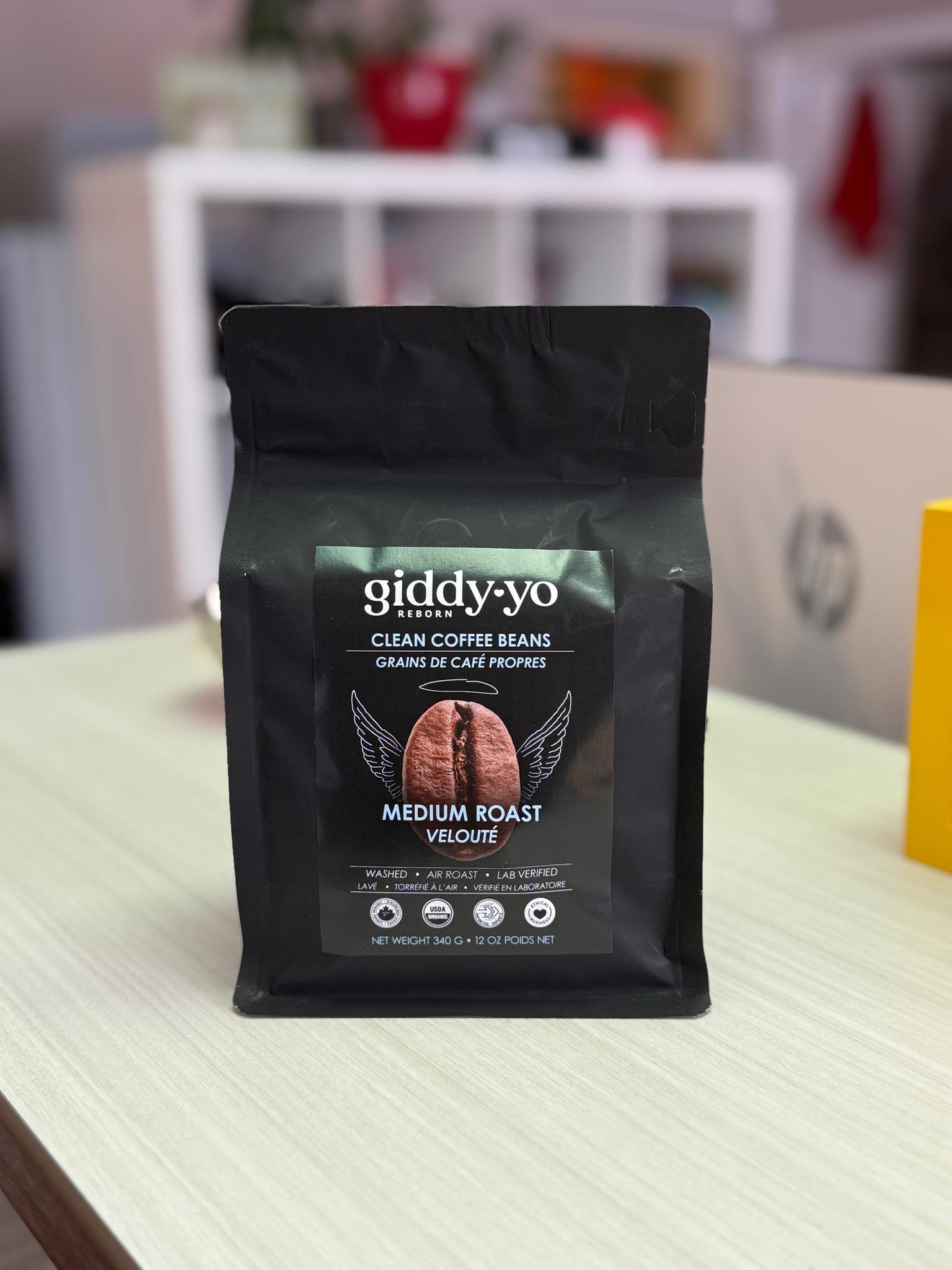
We have so many new and lovely items.
Check out GiddyYo.com or come see us in Orangeville where we have everything on display on our new shelves haha, and we share samples so you can try before you buy.
You can also call us at (844) 443-9696 or email us at service@giddyyoyo.com. Real humans work here and we actually answer the phone, so don't hesitate to kick it old school and give us a ringalingaling.
Stay warm, stay inspired, stay Giddy. We LOVE you!
The Giddy Yo Team
The Giddy Yo Team